

Specialized Monogram Appliance Repair in San Francisco
Mon–Sat: 8:00 AM – 7:00 PM
Water left in the tub after the cycle usually means the drain path is blocked or the pump is not clearing it. Learn the checks to do first and when a technician should step in.
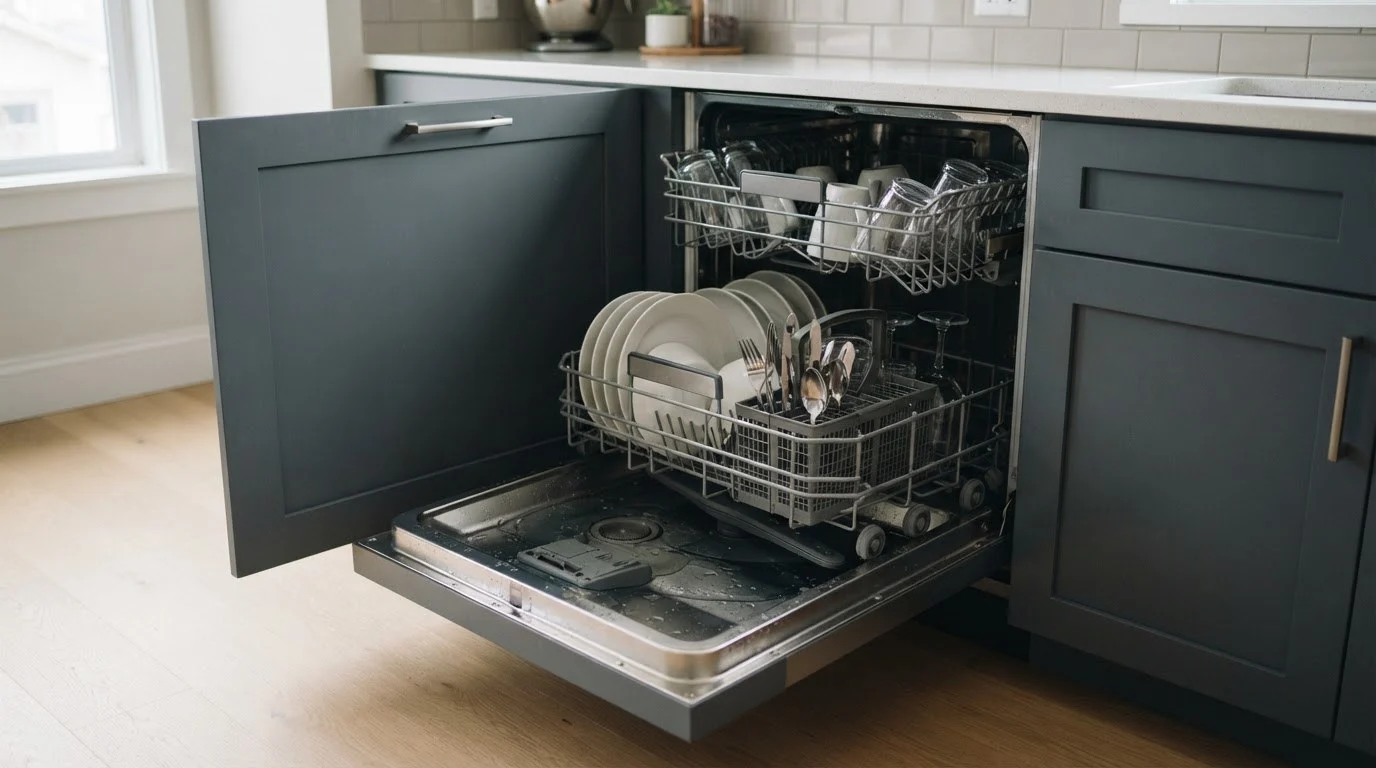
You open the door expecting dry, warm dishes and find a shallow pool in the bottom. A small amount of water is sometimes visible in the sump after a normal cycle, but standing water that sits above the filter or smells stale is not normal. The dishwasher is either not draining or not draining fully.
During a cycle, water is pumped out through a drain hose to the sink drain or a disposer. If any part of that route is blocked, closed, or kinked, water stays behind. Where it stays gives a hint. Water that drains slowly and leaves a thin film behind often points to a partly blocked filter. Water that never moves at all points toward the pump, the hose, or the sink connection.
If the dishwasher shows a code, write it down. Monogram dishwashers have entries for water that does not empty out, such as the flashing rinse light covered on our page about the flashing rinse light on a Monogram dishwasher, and another for a dishwasher that keeps draining, covered under the flashing temp light.
The filter at the bottom of the tub catches food, labels, and bits of glass. If it is clogged, water backs up. With the dishwasher off and the power switched off at the breaker, remove the filter assembly according to your manual, rinse it under running water, and look for debris around it. Check the floor of the tub for a broken piece of glass, a toothpick, or a fruit pit. Do not reach into the drain area with bare hands if you suspect sharp debris. Replace the filter fully and firmly.
Run the kitchen sink and see whether it drains normally. If the sink drains slowly or gurgles, the dishwasher cannot empty into it. If a disposer is connected, the dishwasher hose connects to the disposer inlet, and that inlet may have a knockout plug that was never removed during installation, or a build-up of food. Run the disposer clear while the dishwasher is off.
Look at the drain hose under the sink. It usually loops high before dropping to the drain connection, and that loop keeps sink water from running back into the dishwasher. Look for a kink, a squashed section, or a hose that sags into a trap. In older buildings and condos, the sink plumbing is often shared or has long runs, so a slow drain at the sink is worth mentioning to the building manager or a plumber.
Some installations include an air gap on the countertop or sink deck. If the air gap is clogged with debris, drainage slows. Lift the cap and clear the opening, from the outside only. A technician checks the drain hose, check valve, and pump if the water persists.
If the filter, the hose, and the sink check out, the cause is inside the dishwasher. A technician looks at:
The diagnosis confirms which of these is at fault before anything is replaced. We give you a written estimate, and no repair begins without your approval.
Do not pour drain cleaner into the tub, because the chemicals sit on the parts and can damage seals and plastic. Do not remove the lower access panel or the kick plate to reach the pump. Do not run the dishwasher repeatedly while it is full of water. Do not bail water while the power is on.
If the dishwasher leaks onto the floor, shut off the water supply and the breaker, and see our leak detected page.
A built-in dishwasher sits under the counter with its hoses tucked into a narrow cavity. After a remodel or a countertop change, a hose can be bent sharply or pinched by the cabinet. Panel-ready dishwashers have a front that hides the controls, and a code may only be visible when the door is open. The model number is usually on the door edge or inside the tub, and our post on finding your Monogram model number shows where to look.
A model such as the ZDT800SSYSS, a current 24-inch unit, shares the same basic drain design as other Monogram dishwashers, but pump and valve parts depend on the exact number.
Book when the filter and sink are clear and the water still stands, when the dishwasher hums but does not drain, or when a code returns. Our Monogram dishwasher repair page explains the visit, and the Monogram dishwashers guide covers the lineup. If the cycle also stops before finishing, our post on a Monogram dishwasher that stops mid-cycle is worth reading.
A small amount in the sump below the filter can be normal. Water that covers the filter or smells stale is not.
Yes, and it is the most common cause. Rinse it and check the tub floor for debris.
Intermittent drainage usually points to a partial blockage, a hose that sags at times, or a pump that struggles with debris. Note when it happens.
It can. If the disposer is full or the knockout plug is still in place, the dishwasher cannot drain into it.
A cleaning cycle is fine for odor, but it will not clear a blockage. If water stays, a diagnosis is the safer step.
Share a few details and we’ll confirm an appointment. Prefer to talk? Call us and we’ll help right away.