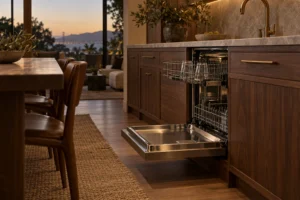
Dishwashers: Lineup, Light Codes and Fixes
Seven Monogram dishwashers in 18 and 24 inch sizes, the eight verified light and message entries, and the checks owners can make…

Specialized Monogram Appliance Repair in San Francisco
Mon–Sat: 8:00 AM – 7:00 PM
Dishwasher faults live in the water in, the water out or the door. We check each path and read the lights before replacing a part.
A dishwasher is one of the few appliances that handles water, heat, electricity and a daily load of dirty plates, so the faults are many and the symptoms overlap. Monogram dishwashers in San Francisco homes are often panel-ready and tucked beside the sink, which makes the cause harder to see. We repair 18-inch and 24-inch models, including the older Monogram dishwashers that many owners kept through a renovation.
Standing water points to the drain path: a clogged filter or screen, a kinked drain hose, a drain pump that is jammed or a disposal knockout that was never removed. Our article on water left in the bottom of the dishwasher goes through the checks.
Upper-rack results that lag behind the lower rack suggest a spray arm problem, a weak circulation pump or a clogged arm. See the guide on an upper rack that is not cleaning for the symptom in detail.
A door that refuses to close or latch can be a bent latch, a misaligned panel, a damaged hinge cable or something resting against the rim. The article on a dishwasher door that will not latch lists the safe checks.
A cycle that halts, restarts or never ends can come from a water level fault, a door switch, a heater circuit or a control. The page on a dishwasher that stops mid-cycle covers common causes.
Monogram dishwashers report problems through lights and short messages. Each one below has its own page:
Write down which lights are lit before you do anything else.
We start with the water in and the water out, because most dishwasher faults live in one of those two paths. Then we look at circulation, the heating and the door and latch. The control comes last, since boards are often blamed for problems that begin in a switch or a hose. You receive a written estimate after the diagnosis, and nothing is repaired until you approve it.
A panel-ready door carries its own weight, and a door spring that was set for one panel weight behaves differently with another. Dishwashers sit under counters with tight clearances, so hoses can be pinched against the cabinet, and a drain hose without a proper high loop lets dirty water flow back. Disposals that share the connection can send food waste into the filter.
Older San Francisco flats may have plumbing that was patched over decades, and low supply pressure or a half-open valve can look like a fill fault. Floors that slope slightly make a door close unevenly. Many condos have shared stacks, so a drain that works during the day may back up at busy hours.
ZDT and ZBD both mark dishwashers. Among current units, the ZDT165SILII is an 18-inch European stainless unit, while the ZDT800SSYSS and ZDT985SSNSS are 24-inch Minimalist models. The ZBD1850NII is one of the discontinued 18-inch dishwashers. Read the label on the door edge or inside the tub, and use our model number guide if you cannot find it.
Do not remove the lower panel, test the door switch with a tool or run the machine while water pools on the floor.
A dishwasher is easier on itself when the filter is cleaned regularly, large bones and seeds are scraped off before loading and the spray arms can spin freely past tall items. Loading a pan across the bottom rack can block the lower arm and leave the upper arm weak. Detergent that sits in a damp dispenser for months can clump and leave residue on glasses, which looks like a cleaning fault. If a smell lingers, check the filter and the bottom of the tub for trapped debris before assuming the pump is at fault.
Hard water in some Bay Area neighborhoods leaves a white film on the tub and glassware, and that film can also coat the heater area. A technician can tell the difference between scale and soap residue, so mention it if you see it.
Stop the cycle and close the water valve if the floor is wet or LEAK DETECTED appears. Power off at the breaker if there is a burning smell or the door area feels hot. Do not keep running a unit that fills but cannot drain.
We confirm the model, read the lights and test fill, drain and circulation in order. If the fix is a hose or a loop rather than a part, we say so. The written estimate lists any part.
The wider lineup is on the Monogram dishwashers page.
The drain path is usually blocked or the pump is not clearing. Filter, hose, high loop, disposal knockout and pump are all candidates.
A possible leak was sensed and the cycle was cancelled. Close the water valve, dry the area and have the base and hoses checked.
Write down the pattern and try one controlled power reset. If it returns, the problem needs a visit.
Yes. A panel that is heavier or misaligned changes how the door closes and where it meets the latch.
No. The lights point to an area, such as drain or fill, and the technician finds what is behind it.
Seven Monogram dishwashers in 18 and 24 inch sizes, the eight verified light and message entries, and the checks owners can make…
Warm drinks, fogged glass, freezing cans and noise in Monogram beverage centers, checked against the seal, airflow and installation. Estimate before any…
Uneven cooling, constant running, drips and door faults on integrated Monogram columns, checked with the cabinetry and airflow in mind. Cabinet heat…
Cooling, frost, leaks and dispenser faults on Monogram French-door and wide built-ins, diagnosed before any part is replaced. We start with the…
Gas burners that misfire and induction zones that cut out or ignore touch, diagnosed at your San Francisco or Bay Area counter…
Frost, soft food, drawer faults and warm cabinets on Monogram built-in freezers, traced to the seal, airflow or defrost cycle before repair.…
Low production, hollow cubes, leaks and blinking lights on Monogram ice makers, with linked code pages and a diagnosis before repair. Estimate…
Built-in microwaves and Advantium speed ovens that stop heating, show SENSOR ERROR or stay locked, diagnosed in your San Francisco or Bay…
Hoods that are loud, weak, light-only or switching on alone, diagnosed in San Francisco and Bay Area kitchens with a written estimate…
Dual-fuel, all-gas and induction Monogram ranges diagnosed in place in San Francisco and the Bay Area, with a written estimate before any…
Gas rangetop burners that will not light, click, or burn yellow, diagnosed in your San Francisco or Bay Area kitchen and repaired…
Built-in Monogram wall ovens and steam ovens that heat slowly, cook unevenly or show an F-code, diagnosed in your San Francisco or…
Temperature drift, vibration, fogged glass and display faults on Monogram wine reserves, diagnosed gently so your collection stays settled. Your bottles stay…
Share a few details and we’ll confirm an appointment. Prefer to talk? Call us and we’ll help right away.