

Specialized Monogram Appliance Repair in San Francisco
Mon–Sat: 8:00 AM – 7:00 PM
A hood that roars yet barely pulls smoke is usually fighting a clogged filter, a blocked duct or a tired blower. Learn what to check from below and when to call.
You turn the hood to high, the room fills with a roar, and the smoke from the pan still drifts past the front edge. A range hood that is loud and weak at once is trying to move air and failing. The cause sits somewhere along the path the air takes: the filters, the blower, the duct or the make-up air in the room.
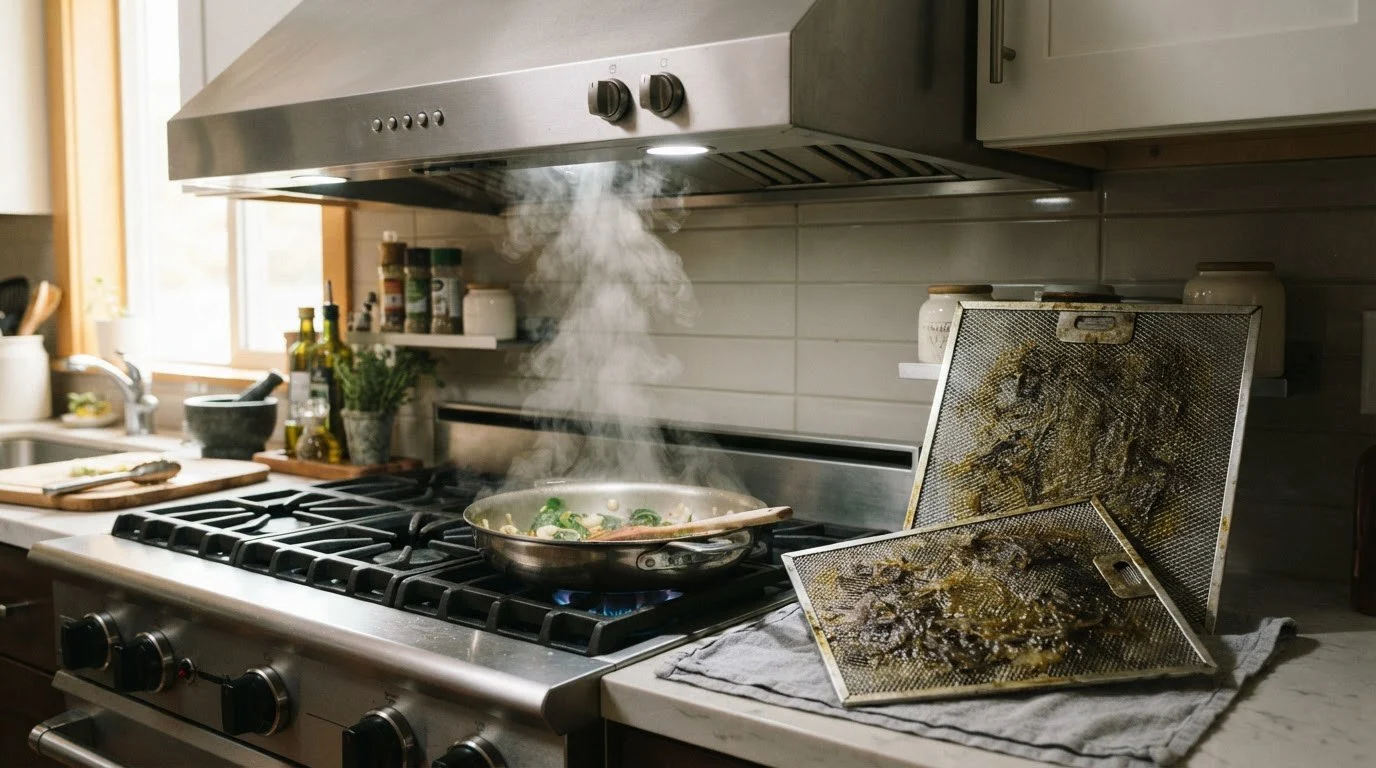
Cooking grease collects in the baffle or mesh filters. When they clog, the blower strains and the sound changes. Most Monogram hoods have filters that slide or release from the underside. Take them out with the fan off and the light cool, wash them in warm soapy water, let them dry completely and refit them with the correct side facing the right way. A filter that is not seated can flap or whistle.
If the filters were visibly greasy, that is probably the whole story. If they were clean and the hood is still weak, move on.
Ducted hoods push air out through a run of pipe to the outside. Anything that restricts that run weakens the hood: a crushed section in a tight wall, a lint or leaf nest in the cap, a stuck flap, or a long run with many bends. From the outside, you can check whether the exterior flap opens when the fan runs. If you can see the cap safely from ground level, look for debris. Do not climb to a roof to do this.
In a flat or condo, shared risers and tight cabinet cavities are common, and the hood may be just one part of a longer path. A technician can tell whether the restriction is the hood or the building side.
A powerful hood pulls air out of the room, and that air has to come from somewhere. In a modern, tightly sealed kitchen, a hood on high can struggle if no window or vent lets replacement air in. A simple test is to crack a window near the kitchen while the hood runs. If the noise drops and the pull improves, the problem is not the hood itself.
If the filters are clean, the duct is clear and the room has air, the blower is next. Signs include:
For any burning smell, switch the hood off and turn it off at the breaker. A blower that is worn, loose or coated in grease needs a technician. Do not remove the lower cover, grille or chimney section to look at it yourself.
If the high speed behaves like a medium one, or the low speed seems to do nothing, the speed control may be at fault rather than the motor. Try each speed in turn and note which ones respond. That information is valuable at the visit. Also check that the hood is not in a delay-off or timer mode, which can make the fan seem to have a mind of its own.
Hoods come in several widths: the UVC9300SLSS is 30 inches, the UVC9360SLSS 36 inches, the UVC9420SLSS 42 inches and the UVC9480SLSS 48 inches, while the ZV1050SFSS is a 42-inch chimney hood and the ZV36RSFSS a 36-inch professional hood. A hood that is too small or mounted too high for its range will always feel weak, whatever its condition. If the hood used to work well and is weak now, that points to a change. If it has always been weak, the installation may be the cause.
The technician listens to the hood at each speed, checks the filters, damper and duct access, looks at the blower wheel and motor, and reads the control response. You get a written estimate that explains what was found, and nothing is repaired until you approve. If the fault is in the building ductwork rather than the hood, we will tell you so you can plan accordingly.
Our Monogram range hood repair page lays out the process, and the Monogram range hoods guide covers the lineup. If your hood has lights but no fan, read when the lights work but the fan does not. For a specific hood, see the UVC9360SLSS or the ZV36RSFSS.
It depends on how much you fry and sear. A household that cooks with high heat and oil every day will need to clean them much more often than one that mostly bakes.
Yes. Noise often comes from an unbalanced blower wheel, a loose cover, or a restriction in the duct, and none of those are fixed by cleaning the filters.
It tells you the room is short of replacement air. The hood itself may be fine, and the fix is on the house side.
Not if something blocks the path. Extra noise with the same weak pull means turbulence in the system, not more capacity.
Yes. A hot or burning smell from the blower is a reason to stop using the hood until a technician has looked at it.
Share a few details and we’ll confirm an appointment. Prefer to talk? Call us and we’ll help right away.