Range Hoods: Widths, Styles and Airflow Faults
Six Monogram range hoods in 30 to 48 inch widths, custom, chimney and professional styles, with advice on noise, weak airflow, lights…

Specialized Monogram Appliance Repair in San Francisco
Mon–Sat: 8:00 AM – 7:00 PM
Ventilation that roars, barely pulls, or runs on its own, traced from the control to the duct.
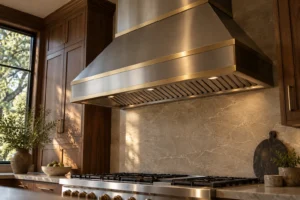
A range hood has two jobs, moving cooking air out and lighting the surface, and owners notice quickly when either stops. Monogram hoods come in custom, chimney and professional styles from 30 to 48 inches wide. We repair them in San Francisco and around the Bay Area, and we treat the hood and its ductwork as one system, because the fault is often in the path rather than the fan.
Noise and poor pull are usually two faces of one problem. A fan wheel with grease buildup becomes unbalanced and rattles. A blower motor with worn bearings grinds. A duct that is kinked, crushed or capped by a flap that no longer opens makes the fan strain and still move little air. A clogged grease filter gives the same symptoms. Our post on a range hood that is loud with weak airflow walks through them in the order a technician would check.
If the lamps come on and the fan stays silent, the control and power are reaching the hood but the blower side is not responding. That might mean a failed motor, a speed control or relay that no longer switches, or a connector that has loosened. The detail is in the post on a hood where the lights work and the fan does not. We listen for a hum, which hints at a stuck or seized motor, versus complete silence, which points toward the control.
A hood that comes on without being touched is unsettling. Possible causes include a control that sees phantom touches because of moisture or grease, a stuck button, or an automatic function responding to something it senses. See a range hood that turns on by itself for the sequence of checks. If the hood switches on and you cannot turn it off, switch it off at the breaker until it is examined.
Kitchens that sear and fry heavily load a hood faster than kitchens that simmer. Grease coats the filters first, then the fan wheel and the housing. A hood that was quiet last year and rattles now may only need a deeper cleaning, and we tell you if that is all it needs. If the buildup has reached the motor, the repair becomes a motor job, and we show you what we found before suggesting it.
Dim, flickering or dead lamps may be a failed bulb, a socket, or a driver, depending on the design. Controls can fail through wear or grease. We inspect the lighting and the controls on every visit so a second trip is not needed.
A hood is tied to the building. In a Victorian flat the duct may run a long way through a wall to a roof or side exit, and in a condo it may share a riser with rules attached. Long runs, many bends, and a wall cap with a stuck damper all reduce airflow. A tighter, newer home also needs air to come in so the hood can pull out. When we diagnose weak airflow we look at the full path, not only the unit, and tell you plainly if the answer lies in the duct. Access matters as well: tall ceilings need a ladder and sometimes a second person. The guide to service access for built-in Monogram appliances lists what to prepare.
The Custom series appears in 30, 36, 42 and 48 inches. The 36-inch Monogram UVC9360SLSS repair page and the 48-inch Monogram UVC9480SLSS repair page are examples. There is also the 42-inch Chimney series Monogram ZV1050SFSS repair page and the 36-inch Professional Monogram ZV36RSFSS repair page. The UVC and ZV prefixes mark hoods. All are listed as current.
We start by running the hood at each speed and noting the sound and the airflow, then check the filters, wheel, motor, control and duct exit. Once the cause is isolated we describe it and give you a written estimate. Diagnosis comes before repair, and nothing is repaired without your approval.
A burning smell, smoke from the hood body, sparks, or a breaker that trips means switching it off at the breaker. Grease that drips from the hood is a fire hazard and needs attention. Do not climb into the hood, open the motor housing or touch the wiring. If a gas appliance is below and you smell gas, leave the home, avoid any switch, and call the gas utility or 911 from outside.
Hoods look similar but use different blowers, filters and control boards, and width matters for parts. The label is usually inside the hood, behind a filter, on the inside wall. Remove the filter with the hood off and read it, or see finding the model number before service.
You send the symptoms and the number. We come to your San Francisco or Bay Area address, test, explain and quote. If you are weighing replacement, read repair or replace for a Monogram appliance.
The Monogram range hoods guide shows the lineup. For the cooking surface beneath, see Monogram rangetop repair or Monogram range repair. See the San Francisco coverage page, or begin on the contact page.
A grease-heavy fan wheel, a clogged filter, a crushed or capped duct and a worn motor can all do this. We check the whole path before naming one.
The control and power reach the hood, so the fault is on the fan side: the motor, a speed control or a connection. A technician tests each.
Yes. Cleaning and refitting grease filters per the manual is a safe owner check, and it can improve airflow.
Moisture, grease or a stuck control can trigger it. If you cannot turn it off, switch it off at the breaker until it is inspected.
We diagnose the whole air path and tell you if the issue is in the duct, so you know what to address next.
Six Monogram range hoods in 30 to 48 inch widths, custom, chimney and professional styles, with advice on noise, weak airflow, lights…
Warm drinks, fogged glass, freezing cans and noise in Monogram beverage centers, checked against the seal, airflow and installation. Estimate before any…
Uneven cooling, constant running, drips and door faults on integrated Monogram columns, checked with the cabinetry and airflow in mind. Cabinet heat…
Cooling, frost, leaks and dispenser faults on Monogram French-door and wide built-ins, diagnosed before any part is replaced. We start with the…
Gas burners that misfire and induction zones that cut out or ignore touch, diagnosed at your San Francisco or Bay Area counter…
Drain, fill, latch and cycle faults on Monogram dishwashers, with each flashing-light message linked and a written estimate first. Estimate comes first.
Frost, soft food, drawer faults and warm cabinets on Monogram built-in freezers, traced to the seal, airflow or defrost cycle before repair.…
Low production, hollow cubes, leaks and blinking lights on Monogram ice makers, with linked code pages and a diagnosis before repair. Estimate…
Built-in microwaves and Advantium speed ovens that stop heating, show SENSOR ERROR or stay locked, diagnosed in your San Francisco or Bay…
Dual-fuel, all-gas and induction Monogram ranges diagnosed in place in San Francisco and the Bay Area, with a written estimate before any…
Gas rangetop burners that will not light, click, or burn yellow, diagnosed in your San Francisco or Bay Area kitchen and repaired…
Built-in Monogram wall ovens and steam ovens that heat slowly, cook unevenly or show an F-code, diagnosed in your San Francisco or…
Temperature drift, vibration, fogged glass and display faults on Monogram wine reserves, diagnosed gently so your collection stays settled. Your bottles stay…
Share a few details and we’ll confirm an appointment. Prefer to talk? Call us and we’ll help right away.