

Specialized Monogram Appliance Repair in San Francisco
Mon–Sat: 8:00 AM – 7:00 PM
A burner that clicks nonstop or will not stay lit is usually damp, dirty or misaligned, but gas safety comes first. Here is what to check and when to stop.
If you smell gas, stop reading and act first. Do not touch switches, do not use the range, leave the home, and call the gas utility or 911 from outside. Everything below assumes there is no gas smell.
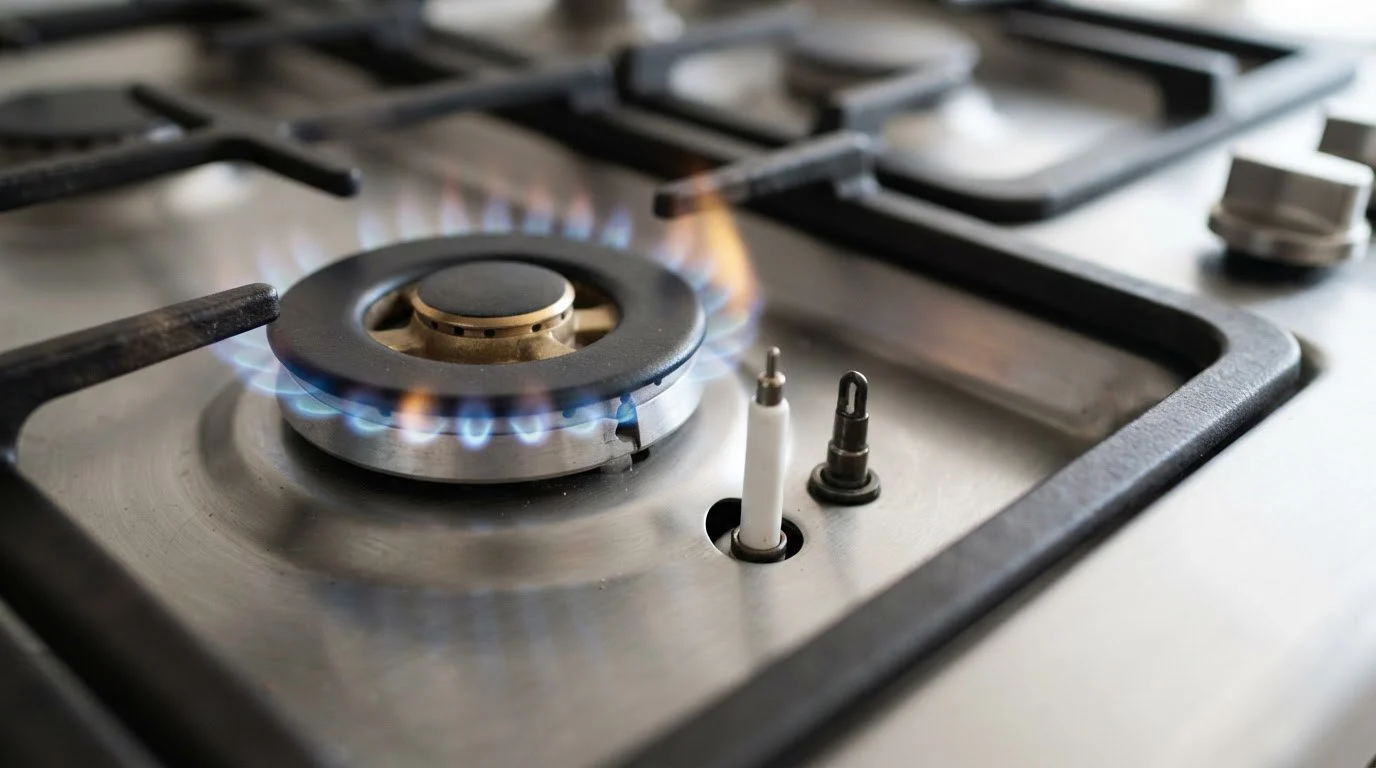
The click-click-click is the spark igniter doing its job. On a gas range, each burner has a spark electrode that fires while the knob is in the light position. Normally the burner catches within a moment and the clicking stops. When it keeps going, or starts on its own, something is interfering with the spark, the flame or the sensing.
Here the spark fires but the gas either does not reach the burner or does not ignite. The electrode may be wet or dirty, the burner cap may be out of position, or the ports may be blocked with boil-over residue.
The flame is on, yet the spark keeps firing. This often comes from moisture, grease or debris around the electrode that lets the spark leak where it should not. It can also come from a burner cap that is slightly off, so the flame is not sitting where the electrode senses it.
If a burner clicks on its own, one of the igniter switches is stuck or wet. Liquid that has run under the knob or around the switch is the typical cause. This is not an owner repair beyond drying and cleaning the surface.
The igniter works by jumping a spark across a small gap to the burner. Anything that conducts, such as water, grease or crusted sugar, gives that spark an easier place to go. That is why the problem so often appears right after a cleaning day, a pot that boiled over, or a humid cooking session, and why it can resolve by itself once the area dries. If it does not resolve, the electrode or the switch has probably been damaged by the contamination, and cleaning alone will not bring it back.
Keep a record of what happened around the time the clicking began. A technician can read that history quickly: a single burner after a spill suggests a dirty or cracked electrode, while several burners after a deep clean suggests moisture in the switches.
Do not light a burner with a match as a routine workaround while the igniter is misbehaving, and never if you have noticed any gas odor. Do not take apart the manifold or loosen any gas connection. Do not spray cleaners into the knob stem or the electrode. Do not remove the cooktop surface. If a burner clicks but never lights and you cannot smell gas, turn the knob off and leave it for a technician.
Book a diagnosis when clicking returns after cleaning and drying, when one burner will not light at all, or when a burner clicks by itself. Book immediately and treat it as urgent if you ever notice a gas smell, a flame that looks wrong, or soot marks around a burner.
A look at the model helps. All-gas ranges like the Monogram ZGP364NDTSS, a 36-inch Statement range, and dual-fuel ranges like the Monogram ZDP364NDTSS share similar gas-burner concerns, though the oven side differs. If the problem is the flame color or an uneven ring, see yellow or uneven flame on a Monogram rangetop.
The technician tests the igniters and switches, checks the cap seating and electrode condition, and looks at the burner ports. Gas connections are inspected only by trained hands. You will receive a written estimate and nothing is repaired without your approval. In a San Francisco flat or a Bay Area condo, a range may sit between tight cabinets, so we plan the access before arriving.
Read more under Monogram range repair or browse Monogram ranges.
The clicking itself is only the igniter, but a burner that clicks without lighting can release unburned gas. If you smell gas, leave and call the gas utility or 911 from outside.
Water around the electrode lets the spark go the wrong way. Let the burners dry completely and seat the caps flat.
A toothpick can clear a bit of residue when the burner is cold. Do not use a metal needle or enlarge the ports.
That points to that burner’s electrode, cap or switch rather than the gas supply as a whole, but it still needs checking before regular use.
Share a few details and we’ll confirm an appointment. Prefer to talk? Call us and we’ll help right away.