

Specialized Monogram Appliance Repair in San Francisco
Mon–Sat: 8:00 AM – 7:00 PM
Resetting too quickly erases the clues a technician needs. Here is the short record to make first: the display, the pattern, the timing and what you were doing.
An appliance shows a message, flashes a set of lights, or beeps, and your first instinct is to switch it off and on. That can clear the display and sometimes the fault. It also wipes the clue. A technician who arrives to a clean display has to start from scratch, while one who is told exactly what the screen showed can start in the right place.
The same display can arise from several causes, and the same cause can show different displays on different models. A flashing light on a dishwasher means something different from a flashing light on an ice maker. What you saw, in what order, and what you were doing helps narrow it quickly. The full code list is on our Monogram error codes hub, and it is a better reference than a guess from memory.
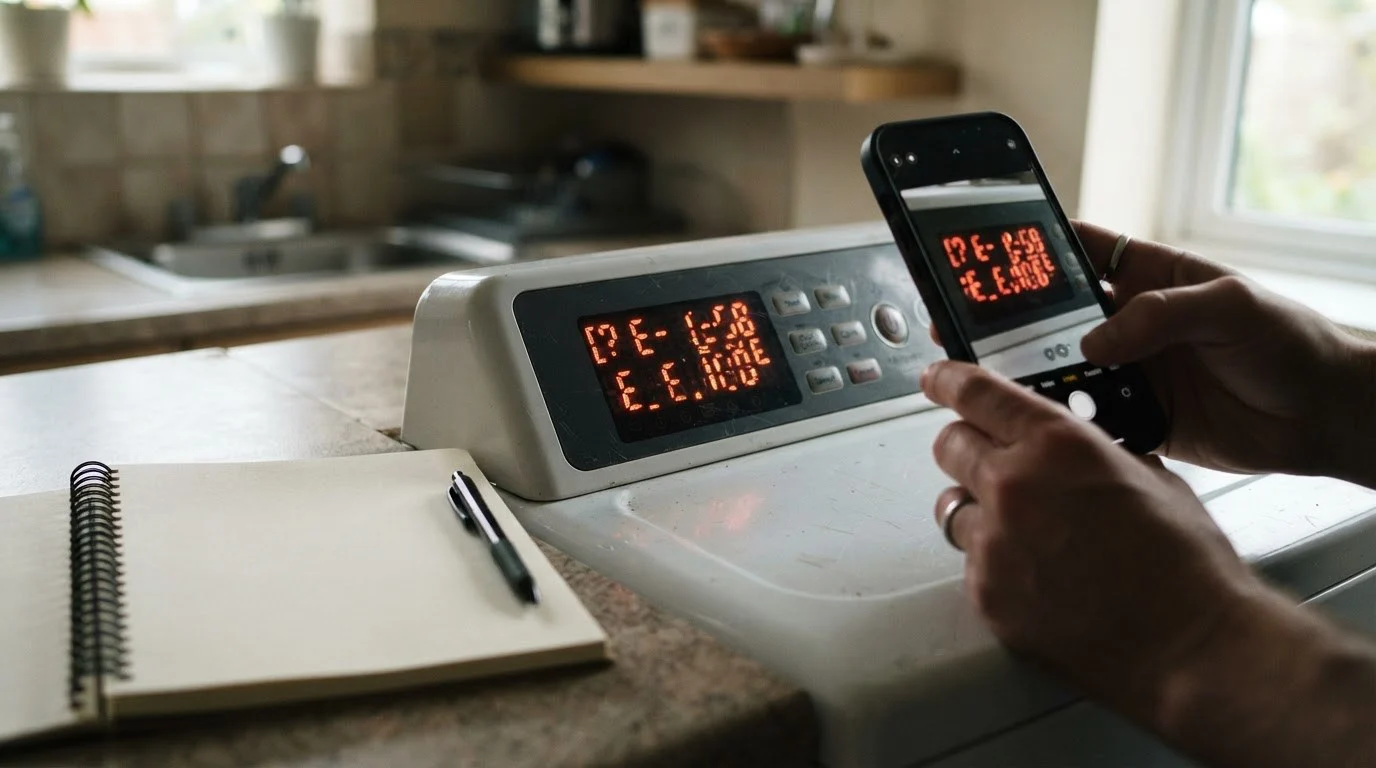
Photograph it if you can, or copy it exactly. Include letters, numbers, symbols, lights that are on, and lights that are flashing. If lights flash in a pattern, count how many times they blink and how long the pause is. Ice makers in particular distinguish faults by blink counts, as on the off light, two blinks and off light, three blinks pages.
Note any beeping, its pattern, and whether it stops by itself. Some dishwashers beep at intervals while lights flash, and that is recorded in the all status lights flashing entry.
Was it in the middle of a cycle, idle, preheating, or filling with water? Which cycle was selected? Was the door open or closed? Context decides which part is suspected.
Did the power flicker? Was a different appliance running on the same circuit? Did you open the door suddenly, move a rack, or fill the water reservoir? Did anyone clean the panel? A short note will do.
Did it show once or several times today? Did it clear on its own? A fault that comes and goes behaves differently from one that stays.
Photograph the nameplate, not the front. Where it sits depends on the appliance, and you will find help in finding your model number. Our Monogram model library shows how models are organized.
Once you have recorded everything, one controlled power reset is reasonable: switch the appliance off at its breaker, wait a short while, and switch it back on. If the appliance works normally, note that too. If the same display returns, you have confirmed the fault is repeatable, which is useful information.
A reset is not a repair. If the message comes back, repeated resets only delay the diagnosis and, in some cases, keep a failing part working under stress.
Dishwashers show blinking lights or a control error, as in the dishwasher control error entry. Wall ovens use F-codes, covered in the wall oven F-codes page. If your display is not listed, a photograph and a written description are the most useful things to have ready for the visit.
A technician can arrive with the right part candidates, ask better questions, and decide faster whether the fault is the control, a sensor, a water path or a heater. You may save a second trip. Our service pages show what a visit covers for each appliance, for instance Monogram dishwasher repair, Monogram wall oven repair and Monogram ice maker repair. The full list is on our Monogram services page.
None of these is serious in itself, but together they turn a clear diagnostic trail into a vague story. Treat the first appearance of a message as the most valuable one. If it appears while you are away from the kitchen, ask a family member to photograph it rather than clearing it, and keep the appliance off the circuit if there is anything beyond a simple display fault.
You can reset once, after recording the display. The point is to capture the clue first, not to avoid a reset altogether.
A clear photo of the display and one of the label is an excellent record. A few typed notes about timing and context make it better.
Describe it as you saw it and bring the photo. The technician will diagnose the actual fault instead of guessing from the code alone.
Not by itself. It points to a system, and the technician confirms the cause by testing before recommending a repair.
Keep a note of it anyway. Intermittent faults often return, and your notes will help pin down the pattern.
Share a few details and we’ll confirm an appointment. Prefer to talk? Call us and we’ll help right away.