Wall Ovens: Models, F-Codes and Heat Problems
Seven Monogram wall ovens in 27 and 30 inch widths, electric and steam, with a plain explanation of F-codes and the safe…

Specialized Monogram Appliance Repair in San Francisco
Mon–Sat: 8:00 AM – 7:00 PM
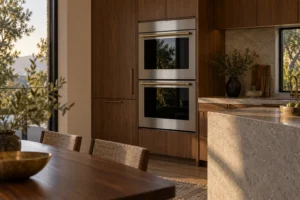
Single, double and steam ovens set into the wall, checked for heat, airflow, door and display faults.
A wall oven is installed once and expected to run for years without attention, so when it misbehaves the first question is usually whether it can be reached without tearing out cabinetry. In most cases it can. We repair Monogram electric wall ovens and steam ovens in San Francisco and throughout the Bay Area, working from the front of the cavity whenever possible.
A cavity that takes much longer to preheat, or never reaches the set point, usually involves a bake or broil element, a temperature sensor, or the relay that feeds them. Our post about an oven with a slow preheat goes through those possibilities in order, and it also covers when the culprit is a door that does not seal.
Dark edges with a pale center, or one rack that always lags, often point to the convection fan, the airflow path, or a sensor reading that no longer matches the cavity. Rack position and pan size matter too, which is why an oven that cooks unevenly gets its own checklist before any part is blamed.
A blank display with a working oven, a stuck or intermittent control, a light that stays on, or a clock that resets are all control-side problems. The touch panel, its ribbon connection and the main board are different parts, and the order in which symptoms appear narrows them down.
A door that sags, a latch that will not release after a clean cycle, or a cooling fan that roars after the oven is off each have their own mechanical explanation. We describe what we hear and see, and then confirm it with the oven open.
When a Monogram wall oven finds a fault, the LCD can show an F followed by a number or a letter. The manual treats it as a generic function error and does not define each individual code, so the display alone is never a final diagnosis. Our Monogram wall oven F-codes page explains what the manual does say and how to write the code down. Record it exactly, along with what the oven was doing, and note whether the code returns after one controlled power reset. The general post on what to record before resetting a Monogram error code describes the notes that help most. You can also browse the full error codes list for other appliances.
The catalog includes both conventional electric wall ovens and steam ovens. The 27-inch Monogram ZKD90DPSNSS repair page covers a Statement series electric oven, while the 30-inch Monogram ZTD90DSSNSS repair page covers a Minimalist series one. For steam, see the 30-inch Statement series Monogram ZMB9032SNSS repair. A steam oven adds a water path to the picture, so we ask about the water reservoir, any scale or odor, and what the oven does when steam is called for.
We start with your account of the problem, then run the oven and watch. We observe whether elements glow, whether fans start, whether the display agrees with what is happening, and how the door behaves. Once the cause is plain, we explain it and provide a written estimate. Diagnosis comes first, and no repair happens until you approve.
A wall oven sits in a cabinet cutout, often stacked under a microwave or above a warming drawer. Hard-wired power comes in at the back or side. Because of that, we can often test and replace parts from the front, but some repairs require sliding the oven out, which can be heavy and needs clear floor and hands. Panel trim, countertops and nearby cabinets are protected. The post on service access for built-in Monogram appliances explains what to prepare, including clearing the area in front.
A burning smell, smoke that does not match the food, sparking, or a breaker that trips again right after reset means switching the oven off at the breaker and leaving it off. Do not open panels, test wiring, or bypass the door switch. If the door will not open after a cleaning cycle, do not force it.
The ZKD, ZTD and ZKS prefixes mark wall ovens, and ZMB marks a steam oven. The remaining letters show the finish and series. The label is usually on the oven frame, along the edge that is hidden when the door closes. Open the door and read the whole number, or use the steps in finding the model number before service.
You tell us the model, the symptom and any code. We come to your San Francisco or Bay Area address, test the oven, and tell you what we find. If a part is needed you see the written estimate first. If you are unsure that repair makes sense, the post on repair or replace for a Monogram appliance is a good place to start.
Our Monogram wall ovens guide describes the lineup. If a microwave or speed oven is stacked above, see Monogram microwave repair. A range with an oven in the base falls under Monogram range repair. Our San Francisco page lists neighborhoods, and the contact page starts a request.
No. The manual treats F-codes as a general function error and does not define individual ones, so a technician uses the code as a clue and then tests the oven.
Common reasons include a weak element, a sensor reading wrongly, or a door that is not sealing. The post on slow preheat walks through them.
Yes. The ZMB steam ovens are covered, and the visit includes the water path as well as the heating and controls.
Often not. Many tests and repairs are done from the front. If the oven must be slid out, we plan for access and protect the surrounding cabinets.
No. We diagnose first, write up the estimate, and wait for your go-ahead.
Seven Monogram wall ovens in 27 and 30 inch widths, electric and steam, with a plain explanation of F-codes and the safe…
Warm drinks, fogged glass, freezing cans and noise in Monogram beverage centers, checked against the seal, airflow and installation. Estimate before any…
Uneven cooling, constant running, drips and door faults on integrated Monogram columns, checked with the cabinetry and airflow in mind. Cabinet heat…
Cooling, frost, leaks and dispenser faults on Monogram French-door and wide built-ins, diagnosed before any part is replaced. We start with the…
Gas burners that misfire and induction zones that cut out or ignore touch, diagnosed at your San Francisco or Bay Area counter…
Drain, fill, latch and cycle faults on Monogram dishwashers, with each flashing-light message linked and a written estimate first. Estimate comes first.
Frost, soft food, drawer faults and warm cabinets on Monogram built-in freezers, traced to the seal, airflow or defrost cycle before repair.…
Low production, hollow cubes, leaks and blinking lights on Monogram ice makers, with linked code pages and a diagnosis before repair. Estimate…
Built-in microwaves and Advantium speed ovens that stop heating, show SENSOR ERROR or stay locked, diagnosed in your San Francisco or Bay…
Hoods that are loud, weak, light-only or switching on alone, diagnosed in San Francisco and Bay Area kitchens with a written estimate…
Dual-fuel, all-gas and induction Monogram ranges diagnosed in place in San Francisco and the Bay Area, with a written estimate before any…
Gas rangetop burners that will not light, click, or burn yellow, diagnosed in your San Francisco or Bay Area kitchen and repaired…
Temperature drift, vibration, fogged glass and display faults on Monogram wine reserves, diagnosed gently so your collection stays settled. Your bottles stay…
Share a few details and we’ll confirm an appointment. Prefer to talk? Call us and we’ll help right away.