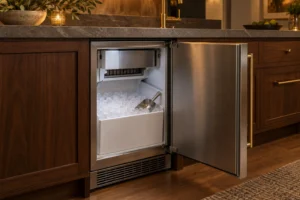
Ice Makers: Clear and Nugget Models Compared
Five Monogram ice maker models, with the four indicator codes, advice on cleaning lights and low production, and safe owner checks.

Specialized Monogram Appliance Repair in San Francisco
Mon–Sat: 8:00 AM – 7:00 PM
Ice makers depend on water, drainage and airflow. We check each one, and read the lights, before we point to a part.
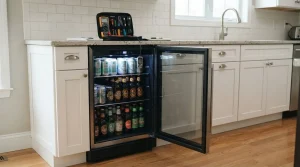
An undercounter ice maker works quietly for months, and then one day the bin is half empty, the cubes look wrong, or a small light starts to blink. Monogram ice makers in San Francisco homes sit in bars, butler pantries and kitchen islands, and they depend on water, drainage and airflow all being right at the same time. We repair the built-in and undercounter units, including clear ice and nugget designs.
Low production can come from a restricted water supply, a dirty condenser area that keeps the unit from shedding heat, a scaled evaporator or a bin sensor that thinks the bin is full. Warm rooms make it worse. Our guide on low ice production walks through what to look at before you book.
Cube quality is a window into the freeze cycle. Hollow or undersized pieces often mean the water is reaching the evaporator in the wrong amount or at the wrong time, while cloudy ice in a clear-ice model can come from mineral build-up in the system. The article on small, hollow ice cubes shows how to read the shape of the ice.
Drips and puddles come from the supply line, the drain connection or an overflowing reservoir. Undercounter units often drain by gravity to a pump or a floor drain, and a drain that is partly blocked leaves water in the tray.
A bin that holds water instead of ice can mean the drain is slow, the door is not sealing or the unit is not cold enough to keep the cubes frozen between harvests.
These units use indicator lights as a language, and the pattern matters more than the color alone. Four conditions have their own pages:
Do not reset the unit repeatedly. Write down the light pattern first, and our note on what to record before resetting an error code says what to capture.
We begin with the basics that most often decide the case: water supply and pressure, the drain, the condition of the condenser and the ice bin. Then we follow the freeze and harvest cycle and the sensors that control it. Cleaning is a real part of maintaining these units, so we also check whether a clean cycle was missed. Before anything is replaced, we explain the finding and give you a written estimate. Nothing is repaired without your approval.
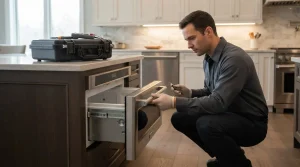
An ice maker built under a counter needs clear air at the front, a supply line with no kinks, a drain that falls away and a level cabinet. Panel-ready units carry a custom door front that adds weight, and a door that does not close fully lets warm air melt the ice. Tight cabinetry around the unit traps the heat the condenser tries to send out.
Water matters too. In parts of the Bay Area, mineral content leaves scale on the evaporator and in the valve screens, which changes cube shape and slows production. Kitchens in older buildings sometimes have supply valves that were never fully opened or have partly seized, and that reads like a failed part.
UNC identifies a nugget ice maker. The UNC15NPWII is a current model needing a custom panel and handle. The ZIBI240HII is a current 24-inch model with a custom panel. For older kitchens, the ZISS48NCSS is a discontinued 48-inch Smart model. Finding the label is usually easy: look inside the cabinet or behind the bin. Our guide on finding the model number has more.
Do not chip ice from the evaporator, use harsh chemicals that are not in the owner materials or open the back. Never ignore a leak.
Ice makers reward a little attention. Keep the front grille free of dust, wipe the bin door seal, and never store boxes against the unit. If you rarely use the machine, empty the bin and let it dry rather than leave stale ice sitting for weeks. Replace the water filter on the schedule in the owner materials, because a clogged filter starves the unit and shortens the harvest.
Turn the ice maker off and close the supply valve if water keeps spreading. Power off at the breaker if there is a burning smell. Do not serve ice from a machine that has been left unclean for a long time or that produces ice with an odd taste or color.
We confirm the model, read the lights, test the water path and the freeze cycle, and explain the cause in plain language. If the answer is a cleaning, a drain or a supply fix rather than a part, we say so.
The overview of the lineup is on the Monogram ice makers page. Neighboring cabinets are covered by Monogram beverage center repair.
The ice maker needs cleaning, and ice production drops or stops if it is left. Cleaning is part of maintenance, and a visit can check for a deeper cause.
The freeze cycle is not getting the right amount of water at the right time. Supply restriction, scale or a valve issue are common causes.
It is a message, not a verdict. Two blinks points to the bin sensor and three blinks to a harvest failure, and both need a technician to confirm.
Mineral scale builds up on the evaporator and valve screens over time. It changes the shape of the ice and can slow production.
No. One controlled reset is fine after you write the pattern down. Repeated resets hide information a technician needs.
Five Monogram ice maker models, with the four indicator codes, advice on cleaning lights and low production, and safe owner checks.
Warm drinks, fogged glass, freezing cans and noise in Monogram beverage centers, checked against the seal, airflow and installation. Estimate before any…
Uneven cooling, constant running, drips and door faults on integrated Monogram columns, checked with the cabinetry and airflow in mind. Cabinet heat…
Cooling, frost, leaks and dispenser faults on Monogram French-door and wide built-ins, diagnosed before any part is replaced. We start with the…
Gas burners that misfire and induction zones that cut out or ignore touch, diagnosed at your San Francisco or Bay Area counter…
Drain, fill, latch and cycle faults on Monogram dishwashers, with each flashing-light message linked and a written estimate first. Estimate comes first.
Frost, soft food, drawer faults and warm cabinets on Monogram built-in freezers, traced to the seal, airflow or defrost cycle before repair.…
Built-in microwaves and Advantium speed ovens that stop heating, show SENSOR ERROR or stay locked, diagnosed in your San Francisco or Bay…
Hoods that are loud, weak, light-only or switching on alone, diagnosed in San Francisco and Bay Area kitchens with a written estimate…
Dual-fuel, all-gas and induction Monogram ranges diagnosed in place in San Francisco and the Bay Area, with a written estimate before any…
Gas rangetop burners that will not light, click, or burn yellow, diagnosed in your San Francisco or Bay Area kitchen and repaired…
Built-in Monogram wall ovens and steam ovens that heat slowly, cook unevenly or show an F-code, diagnosed in your San Francisco or…
Temperature drift, vibration, fogged glass and display faults on Monogram wine reserves, diagnosed gently so your collection stays settled. Your bottles stay…
Share a few details and we’ll confirm an appointment. Prefer to talk? Call us and we’ll help right away.