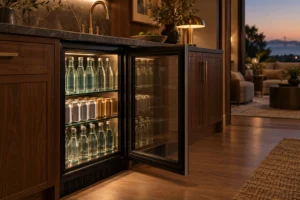
Beverage Centers: Models and Cooling Problems
Five Monogram beverage center models, 24 inch and older units, with notes on weak cooling, glass doors, condensation and the checks owners…

Specialized Monogram Appliance Repair in San Francisco
Mon–Sat: 8:00 AM – 7:00 PM
Beverage centers get opened constantly, so seals and airflow take the strain. We look at both, then at the sensor and the control.
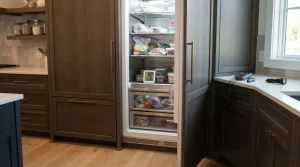
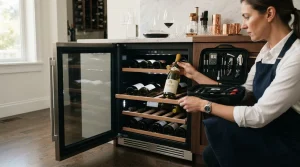
A beverage center is the cabinet you open most often, and that is part of why it fails in particular ways. Monogram beverage centers hold cans, bottles and mixers at a drinking temperature, usually in a bar, a pantry or an entertaining space. When they stop cooling, the effect is felt at the next gathering. We repair the 24-inch integrated beverage centers used across San Francisco homes.
A beverage center that only just cools can be a seal problem, a fan that is no longer moving enough air or a cabinet that is stuffed so full that the air cannot circulate. Frequent opening during a party changes the picture. Our guide on a beverage center that is not cold enough lists the quick checks.
Glass door models show condensation quickly when a seal fails or the surrounding room is humid. Water on the shelf above a bottle collects at the base and may leave a pool you only notice later.
Cans that burst are an expensive surprise, and the cause is a control or sensor that fails to cut the cooling at the right moment. Sensors can be nudged out of place by a rack that has been moved.
A beverage center cycles more than a refrigerator because the door opens often. Constant running with a cabinet that stays warm suggests a cooling fault, while a rattle usually has a simpler mechanical cause, such as a loose shelf or a fan touching something.
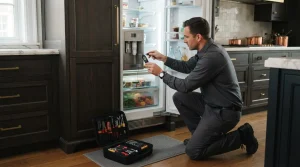
We begin with the door, the gasket and the load. Then we follow the air, check the fan, look at the sensor and confirm that the control responds. A beverage center is not a cabinet where a guess is cheap, so we explain each result before we propose a repair.
You get a written estimate after the diagnosis. Nothing is repaired until you have approved it.
These units are often fitted beneath a counter or beside an ice maker and a sink, in an area that is warm from nearby appliances and wet from daily use. A flush front-vented design depends on the grille staying open, and a toe-kick fitted too tightly or a drawer unit stacked in front can stop airflow altogether.
Outdoor kitchens, covered terraces and garage bars across the Bay Area create more challenges. Foggy mornings and warm afternoons stress the seal, and cabinets that are not rated for the weather can swell. Even a unit under a staircase may be in a space that traps heat, so the surroundings are part of the diagnosis.
Among current models, the ZIBC24PWII takes a custom panel and handle at 24 inches, the ZIDI240HII takes a custom panel, and the ZIDS240NSS is a stainless 24-inch unit. Discontinued designs such as the ZDBC240NBS in European stainless are still in use. The label is typically inside the cabinet on a side wall, and our piece on finding the model number shows other spots.
Do not open the cabinet back, move the unit by its glass door or disconnect anything behind the grille. If glass is chipped or cracked, stop using the door and keep children clear.
Many owners only learn that a beverage center is failing when the house is full. Dozens of door openings, a fresh load of room-temperature bottles and a hot evening can make a healthy unit look weak, and they can make a weak unit look healthy again the next morning. A useful test is to load the cabinet a day before the event, set the temperature where you want it and check the next day. If drinks are still only cool, the fault is real. Note which shelf is warmest, whether the fan can be heard and whether the glass fogs, and give those notes to the technician.
Keep bottle necks away from the rear vent, and avoid stacking cardboard cartons inside, because they hold moisture and block the air path that the cabinet relies on.
If cans or bottles are freezing and cracking, empty the cabinet and switch it off. A burning smell or a buzz from behind the grille means power off at the breaker. Water spreading across the floor or into cabinetry next to it should be mopped and reported at the visit.
If the cabinet sits next to a window or an exterior door, remember that sun on the front panel warms the door glass and the seal. A shade, a rearranged bar or a little air space beside the unit can make a noticeable difference, and it is easier than any repair.
We confirm the model, look at the history and test the cabinet from the outside in. If an outside cause such as heat from a neighboring appliance explains the result, we show you. Any part that needs replacing is listed in the written estimate.
For more about the lineup, read about Monogram beverage centers. A related cabinet that holds ice is covered by Monogram ice maker repair, and bottles stored at a gentler temperature live in Monogram wine reserve repair.
A weak seal, a slow fan or an over-full cabinet can leave the air without enough circulation. We check the load, the door and the fan in that order.
A control or sensor that does not cut cooling at the right moment. A shifted sensor or a failing control board are common causes.
Yes. Heat and humidity from neighboring appliances and a tight surround affect how well it cools, so we look at the whole installation.
Only models intended for that use. Weather and humidity can damage a unit that is not meant for it, and we will tell you if we think that is the cause.
It helps. Read it inside the cabinet on a side wall and note it with the symptom.
Five Monogram beverage center models, 24 inch and older units, with notes on weak cooling, glass doors, condensation and the checks owners…
Uneven cooling, constant running, drips and door faults on integrated Monogram columns, checked with the cabinetry and airflow in mind. Cabinet heat…
Cooling, frost, leaks and dispenser faults on Monogram French-door and wide built-ins, diagnosed before any part is replaced. We start with the…
Gas burners that misfire and induction zones that cut out or ignore touch, diagnosed at your San Francisco or Bay Area counter…
Drain, fill, latch and cycle faults on Monogram dishwashers, with each flashing-light message linked and a written estimate first. Estimate comes first.
Frost, soft food, drawer faults and warm cabinets on Monogram built-in freezers, traced to the seal, airflow or defrost cycle before repair.…
Low production, hollow cubes, leaks and blinking lights on Monogram ice makers, with linked code pages and a diagnosis before repair. Estimate…
Built-in microwaves and Advantium speed ovens that stop heating, show SENSOR ERROR or stay locked, diagnosed in your San Francisco or Bay…
Hoods that are loud, weak, light-only or switching on alone, diagnosed in San Francisco and Bay Area kitchens with a written estimate…
Dual-fuel, all-gas and induction Monogram ranges diagnosed in place in San Francisco and the Bay Area, with a written estimate before any…
Gas rangetop burners that will not light, click, or burn yellow, diagnosed in your San Francisco or Bay Area kitchen and repaired…
Built-in Monogram wall ovens and steam ovens that heat slowly, cook unevenly or show an F-code, diagnosed in your San Francisco or…
Temperature drift, vibration, fogged glass and display faults on Monogram wine reserves, diagnosed gently so your collection stays settled. Your bottles stay…
Share a few details and we’ll confirm an appointment. Prefer to talk? Call us and we’ll help right away.