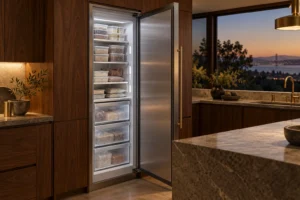
Freezers: Column and Drawer Models Explained
Five Monogram freezer models, from an 18 inch unit to 36 inch columns, with advice on frost, warm spots and safe checks…

Specialized Monogram Appliance Repair in San Francisco
Mon–Sat: 8:00 AM – 7:00 PM
Freezers tell you what is wrong through frost and softness. We read where the ice sits, then follow the seal, airflow and defrost cycle.
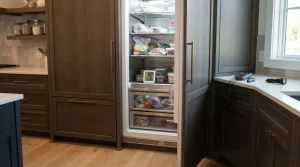
A built-in freezer is easy to ignore until the day a drawer sticks, a layer of frost appears on the wall, or the ice cream goes soft. Monogram freezers in San Francisco kitchens are usually integrated into a bank of cabinetry, beside a matching refrigerator column or beneath a counter. They are simpler than a refrigerator in some ways and less forgiving in others, because a freezer that fails does so slowly and then all at once.
Thick frost on the back wall or around the door is the most common reason owners call. It can mean warm air is entering through a poor seal, or that the defrost system is not clearing the evaporator. A freezer that defrosts correctly rarely shows heavy frost on the walls. When it does, we look at the door first, then the defrost components. Our article on frost around the freezer door shows what to look at.
Soft ice cream, freezer-burned packages and ice crystals on the surface of food can come from a temperature that swings up between cycles. Fan trouble, a control reading the wrong temperature or an over-full cabinet blocking air can all cause it. Frequent door opening during a party week makes the symptom worse and can hide the real fault.
If the motor is audible and the cabinet stays warm, the problem sits in the airflow, the defrost cycle or the sealed cooling circuit. We confirm which before we speak about repair.
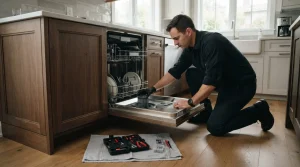
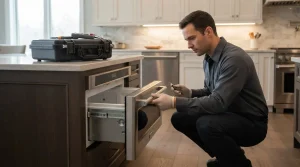
A drawer-style freezer depends on a glide and a gasket that must meet evenly. A bent track, an overloaded basket or ice jammed in the slide keeps the drawer from closing, and an unclosed drawer fills the cabinet with frost within a day.
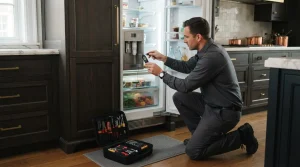
We check the gasket and the closing action, the cleanliness of the condenser area, and the movement of air across the evaporator. Then we look at the defrost cycle and the control. Freezers hide their faults in ice, so a careful look at where the frost sits tells us a lot. We explain what we see, and we do not remove or replace anything without your go-ahead.
A written estimate follows the diagnosis.
Integrated freezers need space to breathe at the base, and they are sensitive to the warmth of neighbors. A freezer column installed beside a gas range or an oven wall can pick up heat through the shared side panel. In garages and basements, an under-counter freezer can face temperature swings that a kitchen unit never sees, and Bay Area foggy mornings followed by warm afternoons are enough to change how often a unit cycles.
Custom panels add door weight, and a door that does not return fully to the cabinet leaves a gap that is hard to see. We check the hinge, the level and the panel together.
Several freezer designations share the ZIC family look with refrigerators, so the label matters. Among the current 36-inch models we see the ZIC360NNRH and the ZIC363IPVRH, both needing a custom panel and handle. The ZICS360NNLH is the universal stainless version. At the narrow end, the ZIF181NBRII is an 18-inch integrated freezer. The label is usually on the inside wall, and our guide to finding the model number covers the other places it can be.
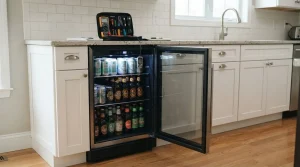
Do not open panels, use sharp tools near the evaporator or pour hot water inside. For a broader look at a cabinet that is not cold enough, the piece on a beverage center that is not cold enough shows a similar approach.
Freezers rarely announce a failure. The compressor keeps running, the light still comes on and the cabinet feels cold to the hand. Meanwhile the temperature creeps upward a little at a time, and food quality drops long before anything melts. If you have noticed ice crystals on packaging, a stale taste in frozen bread or a coat of frost that returns soon after you wipe it, treat those as early signs rather than quirks. A technician can often tell from the pattern of frost whether the seal, the fan or the defrost path is responsible, and the earlier we look, the less food and cabinet moisture are involved.
If the freezer has thawed and refrozen in a block, the food is not safe to keep. Turn the unit off at the breaker if you smell burning or hear a crackle from the electrical side. A freezer that has lost power for a long time should be left alone until a technician has seen it, because restarting a cabinet full of meltwater can spread water into the floor.
We confirm the model, ask about the history and test the cooling system step by step. If the problem lies in the installation rather than the appliance, such as a blocked grille or a neighbor that heats the cabinet, we point to it. If a part is needed, you receive the written estimate and decide.
Learn more about the lineup on the Monogram freezers page. For the refrigerator half of a paired installation, see Monogram refrigerator repair.
Warm moist air is usually getting in or the defrost system is not clearing the coil. A weak door seal, a drawer that does not close or a failed defrost part each produce frost, and we find which one it is.
A little softness after a long door opening is normal. Persistent softness means the temperature is swinging, which points to airflow, control or seal trouble.
You can empty it and let it thaw with the power off, keeping towels down for the water. Do not use sharp tools or heaters on the walls, and tell the technician what you saw.
It can. Heat passes through a shared panel and makes the freezer cycle longer. We check clearances and the surrounding panel.
We see the ZIC, ZIF and ZICS freezers and many older built-ins. Read your model label and we will take it from there.
Five Monogram freezer models, from an 18 inch unit to 36 inch columns, with advice on frost, warm spots and safe checks…
Warm drinks, fogged glass, freezing cans and noise in Monogram beverage centers, checked against the seal, airflow and installation. Estimate before any…
Uneven cooling, constant running, drips and door faults on integrated Monogram columns, checked with the cabinetry and airflow in mind. Cabinet heat…
Cooling, frost, leaks and dispenser faults on Monogram French-door and wide built-ins, diagnosed before any part is replaced. We start with the…
Gas burners that misfire and induction zones that cut out or ignore touch, diagnosed at your San Francisco or Bay Area counter…
Drain, fill, latch and cycle faults on Monogram dishwashers, with each flashing-light message linked and a written estimate first. Estimate comes first.
Low production, hollow cubes, leaks and blinking lights on Monogram ice makers, with linked code pages and a diagnosis before repair. Estimate…
Built-in microwaves and Advantium speed ovens that stop heating, show SENSOR ERROR or stay locked, diagnosed in your San Francisco or Bay…
Hoods that are loud, weak, light-only or switching on alone, diagnosed in San Francisco and Bay Area kitchens with a written estimate…
Dual-fuel, all-gas and induction Monogram ranges diagnosed in place in San Francisco and the Bay Area, with a written estimate before any…
Gas rangetop burners that will not light, click, or burn yellow, diagnosed in your San Francisco or Bay Area kitchen and repaired…
Built-in Monogram wall ovens and steam ovens that heat slowly, cook unevenly or show an F-code, diagnosed in your San Francisco or…
Temperature drift, vibration, fogged glass and display faults on Monogram wine reserves, diagnosed gently so your collection stays settled. Your bottles stay…
Share a few details and we’ll confirm an appointment. Prefer to talk? Call us and we’ll help right away.