Column Refrigerators: Widths, Series and Faults
Six integrated Monogram column refrigerators from 24 to 36 inches, three of them discontinued, with label locations, typical faults and safe checks…

Specialized Monogram Appliance Repair in San Francisco
Mon–Sat: 8:00 AM – 7:00 PM
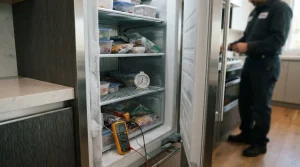
A column refrigerator lives inside its cabinet, so its faults often start with air, heat and door weight. We check all three first.
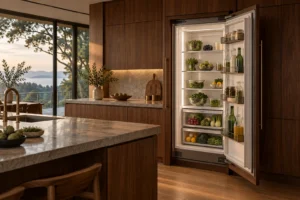
Column refrigerators are the tall, narrow units that disappear into a wall of cabinetry, often paired with a matching freezer column. They put a lot of cooling hardware into a small footprint, and they leave very little room for a mistake in the installation. We repair the integrated columns that Monogram owners in San Francisco rely on, in the 24, 30 and 36-inch widths.
A tall cabinet depends on moving air. When the top shelf is cold and the bottom drawers are warm, or the reverse, the cause is usually an airflow problem: a fan that has slowed, a duct blocked by frost, or a damper that is not following the control. Food packed tightly against the back vents can mimic the same fault, which is why we look at how the unit is loaded as well as how it runs.
When a column runs all day, we think about heat. The cooling system rejects heat into the cabinetry around it, and a unit boxed in by tight panels cannot shed it. A worn door seal or a door that does not close fully adds to the load. Our troubleshooting piece on a column refrigerator that runs constantly covers the checks you can make before booking.
Moisture on the inside walls, drips on the shelf glass or water at the floor of the cabinet point to humid air getting in or to a drain that is not carrying meltwater away. In a column the drain path is short but easy to block, and the water has nowhere to go but the crisper area.
Interior lighting that fails, a control that stops responding, or a door that will not stay shut each have their own cause. A door on a column hangs on a hinge system that carries the weight of a custom panel, and hinge wear shows up as a gap along the latch side long before the door visibly sags.
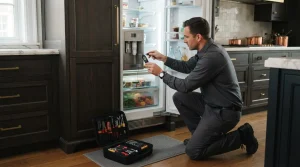
We begin with the door seal and the clearances, because they are quick to check and often decisive. After that we follow the air from the evaporator through the ducts to the shelves, confirm that the defrost cycle clears the coil, and look at the control. A column is not a place for guesswork, and we would rather spend time on a careful test than replace a fan that was never the issue.
The written estimate comes after we have seen the fault. We do not repair anything without your approval.
Panel-ready columns are installed with a custom panel and handle, and the weight of that panel changes how the door closes. Units that are flanked by a freezer column share a side wall, and the ventilation grille at the base is often the only air path. A decorative toe-kick fitted tightly across the grille will starve the unit of air.
In older Victorian kitchens, the floor under a column may not be perfectly level, and a unit that leans slightly forward can swing its door open on its own. In condos, the electrical outlet is typically inside the cabinet, so we confirm that the plug is seated and the circuit is steady before looking at the appliance itself.
The ZIR prefix marks an integrated column refrigerator. In the current catalog we see the ZIR241NBRII at 24 inches, the ZIR301NBRII at 30 inches and the ZIR361NBRII at 36 inches, all needing a custom panel and handle. Discontinued units still turn up in houses that were renovated years ago, and the ZIRP360NHLH in professional stainless is one of them. Knowing which one you own tells us which parts and which manuals apply.
The label is usually on the inside wall near the top, or on the door frame. Our article on finding the model number before service shows where else to look.
Do not remove trim, pull the column out of the opening or touch the cooling lines at the back. If you have lost power for a long time, give the unit a while to settle, and write down what the display shows before you change anything.
Switch the unit off at the breaker if there is a burning smell, a sizzling sound or water near the plug. Remove perishable food if the cabinet is warm to the hand and stays that way. A column that has been dripping water for several days should be looked at before the cabinet beneath it swells.
We confirm the model and the history, test the cabinet from the outside in, and explain each finding in plain language. If the issue sits in the surrounding installation, we show you where. Parts, if needed, are listed in the written estimate.
To compare the lineup, see Monogram column refrigerators. Freezer columns are covered under Monogram freezer repair.
The air path is usually unbalanced. A slow evaporator fan, a damper that stays partly closed or frost on the coil can leave the lower section short of cold air. A technician checks the airflow before suggesting a part.
Yes. The unit must shed heat into the space around it, and a base grille covered by trim or a tight surround holds that heat in. The compressor then works for longer.
Meltwater that does not reach the drain. The drain can freeze or clog with debris, and the water collects where the crispers sit.
It can be. Hinge wear, a heavy custom panel or an unlevel floor can all do it. We check the hinges and the level before anything else.
Usually on the inside wall near the top of the cabinet or on the door frame. Take a photo of the label and keep it handy.
Six integrated Monogram column refrigerators from 24 to 36 inches, three of them discontinued, with label locations, typical faults and safe checks…
Warm drinks, fogged glass, freezing cans and noise in Monogram beverage centers, checked against the seal, airflow and installation. Estimate before any…
Cooling, frost, leaks and dispenser faults on Monogram French-door and wide built-ins, diagnosed before any part is replaced. We start with the…
Gas burners that misfire and induction zones that cut out or ignore touch, diagnosed at your San Francisco or Bay Area counter…
Drain, fill, latch and cycle faults on Monogram dishwashers, with each flashing-light message linked and a written estimate first. Estimate comes first.
Frost, soft food, drawer faults and warm cabinets on Monogram built-in freezers, traced to the seal, airflow or defrost cycle before repair.…
Low production, hollow cubes, leaks and blinking lights on Monogram ice makers, with linked code pages and a diagnosis before repair. Estimate…
Built-in microwaves and Advantium speed ovens that stop heating, show SENSOR ERROR or stay locked, diagnosed in your San Francisco or Bay…
Hoods that are loud, weak, light-only or switching on alone, diagnosed in San Francisco and Bay Area kitchens with a written estimate…
Dual-fuel, all-gas and induction Monogram ranges diagnosed in place in San Francisco and the Bay Area, with a written estimate before any…
Gas rangetop burners that will not light, click, or burn yellow, diagnosed in your San Francisco or Bay Area kitchen and repaired…
Built-in Monogram wall ovens and steam ovens that heat slowly, cook unevenly or show an F-code, diagnosed in your San Francisco or…
Temperature drift, vibration, fogged glass and display faults on Monogram wine reserves, diagnosed gently so your collection stays settled. Your bottles stay…
Share a few details and we’ll confirm an appointment. Prefer to talk? Call us and we’ll help right away.