Rangetops: What Owners Should Know
A practical look at professional-style Monogram rangetops, with typical burner and ignition faults, installation points, gas safety and what to check before…

Specialized Monogram Appliance Repair in San Francisco
Mon–Sat: 8:00 AM – 7:00 PM
Open-burner rangetops that light badly or burn unevenly, checked burner by burner.
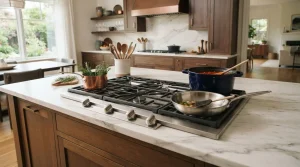
A rangetop is the cooking surface of a professional-style kitchen without an oven underneath: open gas burners set into a stainless body, usually under a hood. Repair work on one is mostly about flame, igniters and gas delivery, since there is no oven circuit to complicate things. We service Monogram rangetops in San Francisco and across the Bay Area, and we always find the cause before proposing a part.
The flame tells a technician a great deal. A tall yellow or ragged flame suggests a restricted burner port, a misaligned cap, or an air and gas mix that has drifted. A flame that lifts away from the burner or sputters points toward blocked ports or an uneven supply. A flame that burns on one side of the ring only usually means debris sits in part of the burner. Our post on a rangetop with a yellow or uneven flame covers how to tell cleaning issues from supply issues.
Most rangetop burners light by spark. If a burner never lights, a technician checks the igniter electrode, the spark module that feeds it, and whether gas actually reaches the port. Constant clicking after the flame is lit often means a wet or dirty electrode. If one burner works and its neighbor does not, the fault is local to that burner. If none work, the shared supply or module becomes the suspect. The post on a gas burner that keeps clicking explains the clicking pattern, and the same logic applies to a rangetop.
A knob that feels loose, spins past its stop, or no longer clicks into the light position can mean a worn valve stem or a failing switch. These parts sit under the surface, so we remove the rangetop’s top components in a controlled order. Gas fittings stay untouched unless a repair requires it, and any work on the gas path is done with the supply shut off and the connection checked afterward.
A rangetop sits in a cutout, often over a cabinet, with a gas line entering from below and a hood overhead. That layout shapes the visit. We need to know what is under the unit, whether a drawer or panel blocks the underside, and where the shut-off valve is. In many San Francisco kitchens the cabinet beneath holds pots, and clearing it before the appointment saves time. The post about service access for built-in Monogram appliances lists what to clear.
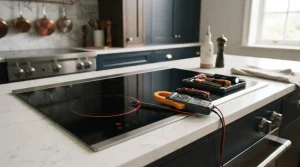
The ZGU prefix on a Monogram model label identifies a gas cooktop or rangetop. Our model pages for that prefix are grouped with cooktops, so if your label begins with ZGU, the Monogram cooktops guide is the nearest match, and you can read about Monogram cooktop repair for the shared diagnosis steps.
If you smell gas, do not turn on a light, use a switch or light a flame. Walk out of the home and call the gas utility or 911 from outside. A rangetop that keeps ticking while a burner stays unlit may be releasing gas, so shut the knobs and leave the burners off. A burning smell, sparks or a tripped breaker also means stopping and switching off at the breaker. Do not open the rangetop, touch gas fittings, or bypass anything to keep cooking.
We start by watching a burner try to light. The spark, the sound of gas and the flame shape each give a clue. Then we check the cap and port condition, the igniter, the module and the supply in that order, eliminating one at a time. We explain what we found before discussing a repair. Diagnosis comes first, you receive a written estimate, and nothing is repaired until you approve it.
Natural gas and liquid propane units use different orifices, and width changes how many burners and valves sit in the body. The label is typically on the underside of the unit or on a data plate inside the cabinet cutout, so read it before you start a request. If you cannot reach it, the guide on finding the model number before service offers other places to look. Supplying the full number lets us bring matching parts.
You describe the symptom and share the number. We arrive, remove the grates, and run the burners one at a time. Some problems are resolved by cleaning and reseating parts, and we tell you when that is the case. Others need a new igniter, valve or module, in which case you get the written estimate first. If the rangetop is old enough that repair is hard to justify, our post on repair or replace for a Monogram appliance lays out the questions to ask.
Our Monogram rangetops guide shows the lineup and common complaints. If your surface is induction, read the induction cooktop that shuts off post. For a range with an oven below, go to Monogram range repair. We cover San Francisco and the surrounding Bay Area, and requests start on the contact page.
A yellow or ragged flame can come from a dirty burner port, a cap that is not seated, or a gas and air mix that needs adjusting. A technician finds out which before changing anything.
Clicking should stop once a flame is established. If it continues, a wet or dirty igniter electrode is a common cause and worth checking.
A unit has to match its fuel, because the burner orifices differ. The model number tells us which version you have.
Clear it before the visit if you can. Access from below helps the technician reach valves and the gas connection safely.
No. We diagnose first, write up the estimate, and wait for your approval before any repair.
A practical look at professional-style Monogram rangetops, with typical burner and ignition faults, installation points, gas safety and what to check before…
Warm drinks, fogged glass, freezing cans and noise in Monogram beverage centers, checked against the seal, airflow and installation. Estimate before any…
Uneven cooling, constant running, drips and door faults on integrated Monogram columns, checked with the cabinetry and airflow in mind. Cabinet heat…
Cooling, frost, leaks and dispenser faults on Monogram French-door and wide built-ins, diagnosed before any part is replaced. We start with the…
Gas burners that misfire and induction zones that cut out or ignore touch, diagnosed at your San Francisco or Bay Area counter…
Drain, fill, latch and cycle faults on Monogram dishwashers, with each flashing-light message linked and a written estimate first. Estimate comes first.
Frost, soft food, drawer faults and warm cabinets on Monogram built-in freezers, traced to the seal, airflow or defrost cycle before repair.…
Low production, hollow cubes, leaks and blinking lights on Monogram ice makers, with linked code pages and a diagnosis before repair. Estimate…
Built-in microwaves and Advantium speed ovens that stop heating, show SENSOR ERROR or stay locked, diagnosed in your San Francisco or Bay…
Hoods that are loud, weak, light-only or switching on alone, diagnosed in San Francisco and Bay Area kitchens with a written estimate…
Dual-fuel, all-gas and induction Monogram ranges diagnosed in place in San Francisco and the Bay Area, with a written estimate before any…
Built-in Monogram wall ovens and steam ovens that heat slowly, cook unevenly or show an F-code, diagnosed in your San Francisco or…
Temperature drift, vibration, fogged glass and display faults on Monogram wine reserves, diagnosed gently so your collection stays settled. Your bottles stay…
Share a few details and we’ll confirm an appointment. Prefer to talk? Call us and we’ll help right away.