Built-In Refrigerators: Lineup and Common Problems
Seven built-in Monogram refrigerator models from 30 to 42 inches, where to find the model label, the complaints we see most, and…

Specialized Monogram Appliance Repair in San Francisco
Mon–Sat: 8:00 AM – 7:00 PM
Built-in refrigerators hide their faults behind panels and grilles. We trace the airflow, the defrost path and the door seal before we suggest a part.
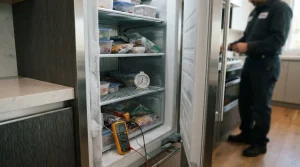
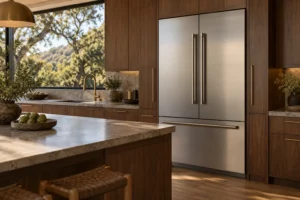
A built-in Monogram refrigerator sits flush with the cabinetry, wears a custom panel or a stainless face, and is expected to hold its temperature without anyone thinking about it. When it stops doing that, the symptoms rarely point at one obvious part. We repair the French-door and wide built-ins that Bay Area kitchens use, from the narrower 30-inch units up to the wide 42-inch ones.
A warm compartment can come from a failing evaporator fan, a defrost system that has stopped clearing the coil, a damper that no longer opens, or a door that is not sealing. Food freezing at the back of the shelves usually points the other way: a damper stuck open, a control reading the wrong temperature, or airflow concentrated on one side. The two complaints look like opposites and often share a root cause in the air path.
Frost on the freezer back wall, ice under the crisper drawers or a pool of water at the base all tell a technician where to look. Meltwater that cannot leave the defrost drain refreezes and builds up, and a frozen drain is a different repair from a failed defrost heater. Telling them apart is the purpose of the diagnosis.
A refrigerator that never seems to stop may be fighting a bad gasket, a dirty condenser area, a door left slightly open by a panel that is too heavy, or a fan that is struggling. A rattle or a loud hum can be as simple as a fan blade touching frost. We listen first, then trace the sound to its source.
Slow dispensing, a dispenser that clicks without delivering, or ice that is small and clumped usually involves the water path: supply valve, inlet valve, filter housing or the freezing of a line. Our guide on a slow refrigerator water dispenser walks through the symptom in more detail.
We start with the history: when the problem began, whether a power cut or a long absence came before it, and whether the door panel was changed recently. Then we check the cabinet environment, the seal, the fan paths, the defrost cycle and the control. A refrigerator can be made to look healthy for an hour and fail overnight, so we explain what we saw and what we could not see yet, and we do not replace parts on a hunch.
You receive a written estimate after the diagnosis. Nothing is repaired until you approve it.
Built-in refrigerators depend on the opening around them. The unit needs clear room for air to enter and leave through the grille at the base, and the surrounding panels must not trap heat. In older San Francisco flats where cabinetry was reworked, the grille is sometimes blocked by a toe-kick that was added later. A custom door panel adds weight to the door, and a door that sags will not close fully against the gasket even though it looks shut.
Water-line placement matters as well. Built-ins in condos often have a supply line that runs through a tight cabinet bay, and a kinked or pinched line produces symptoms that look like a failed valve. On hillside homes with long runs of plumbing, a supply that is only slightly restricted can be mistaken for a dispenser fault.
Built-in refrigerators do not have code pages, so we work from the symptom and from the model. Write down anything the display shows before you power the unit off and on. Our note on what to record before resetting a Monogram error code explains what is useful to a technician.
The prefix tells us the family. ZIP models are French-door built-ins, and the other prefixes in the lineup differ in layout. Two refrigerators of the same width can use different panel requirements and different internal layouts, so the full model number lets us arrive with the right information. Our guide to finding your Monogram model number shows where the label usually sits: on the inside wall of the fresh-food section or along the door frame.
Some models we see regularly include the ZIP360NN, a 36-inch built-in with custom panels and handles, the ZIPS360NNSS in universal stainless, and the 42-inch ZIS420NNII. The ZIP364IPVII is another current 36-inch model.
Do not open panels, move the unit by pulling on the door, or work on anything in the sealed cooling system. If you want to see how a short problem develops, our article on refrigerator freezing food lists the checks in order.
Move food to another cooler if the fresh-food section stays warm. Turn the refrigerator off at the breaker if you smell burning, hear buzzing from the electrical area, or see water spreading across the floor near a plug. If the freezer has thawed, do not refreeze the food. Wait for the service visit before you restart a unit that tripped a breaker.
We confirm the model and the symptom, pull the unit forward only as far as the installation allows, and test the cooling system in stages. If the problem is outside the appliance, such as a blocked grille, a supply fault or an uneven floor, we say so. If a part is needed, you get a written estimate and decide.
The wider story of the lineup is on the Monogram refrigerators page. For tall, narrow units, see Monogram column refrigerator repair.
Usually the cold air is not reaching the fresh-food section. A blocked damper, a failed evaporator fan or a frost-clogged coil all produce this pattern. A technician traces the airflow before replacing anything.
Yes, indirectly. A heavy panel can cause the door to sag and rest against the gasket unevenly, so it never seals. That lets warm air in and makes the unit run longer.
Dry the area, check that the water supply line is not leaking, and clear the grille. Water that keeps returning often comes from a frozen defrost drain or a failing inlet valve, which needs a visit.
It helps a great deal. Read it from the label inside the cabinet or along the door frame and keep it with the symptom notes.
Not for long. Move perishable items to another cooler and wait for the diagnosis rather than trusting the dial.
Seven built-in Monogram refrigerator models from 30 to 42 inches, where to find the model label, the complaints we see most, and…
Warm drinks, fogged glass, freezing cans and noise in Monogram beverage centers, checked against the seal, airflow and installation. Estimate before any…
Uneven cooling, constant running, drips and door faults on integrated Monogram columns, checked with the cabinetry and airflow in mind. Cabinet heat…
Gas burners that misfire and induction zones that cut out or ignore touch, diagnosed at your San Francisco or Bay Area counter…
Drain, fill, latch and cycle faults on Monogram dishwashers, with each flashing-light message linked and a written estimate first. Estimate comes first.
Frost, soft food, drawer faults and warm cabinets on Monogram built-in freezers, traced to the seal, airflow or defrost cycle before repair.…
Low production, hollow cubes, leaks and blinking lights on Monogram ice makers, with linked code pages and a diagnosis before repair. Estimate…
Built-in microwaves and Advantium speed ovens that stop heating, show SENSOR ERROR or stay locked, diagnosed in your San Francisco or Bay…
Hoods that are loud, weak, light-only or switching on alone, diagnosed in San Francisco and Bay Area kitchens with a written estimate…
Dual-fuel, all-gas and induction Monogram ranges diagnosed in place in San Francisco and the Bay Area, with a written estimate before any…
Gas rangetop burners that will not light, click, or burn yellow, diagnosed in your San Francisco or Bay Area kitchen and repaired…
Built-in Monogram wall ovens and steam ovens that heat slowly, cook unevenly or show an F-code, diagnosed in your San Francisco or…
Temperature drift, vibration, fogged glass and display faults on Monogram wine reserves, diagnosed gently so your collection stays settled. Your bottles stay…
Share a few details and we’ll confirm an appointment. Prefer to talk? Call us and we’ll help right away.